Arabic : https://kedencentre.org/2025/08/03/khartoum-slum-clearance-campaigns/
In July of last month, local authorities in the states of Khartoum and Gezira launched extensive campaigns to remove informal settlements, targeting residential areas housing thousands of displaced persons and survivors from conflict zones, without providing alternatives or legal guarantees to protect the affected groups from displacement and exposure. While the Khartoum state government announced the implementation of 60% of its plan to remove what it describes as “slums,” the Committee for the Removal of Random Housing in Gezira state began a field campaign in the Abdullah Masri area east of Wad Madani, using heavy machinery and forced eviction without prior warning or clear grievance procedures.
These campaigns come amidst a protracted armed conflict and a near-total collapse of the legal and social protection system in Sudan, making these policies affect vulnerable, severely impacted groups, most of whom are displaced persons and survivors who fled conflict areas and temporarily settled on the outskirts of cities in search of safety. Midan249 Observatory has documented that these evictions were often carried out without judicial oversight or humanitarian assessment of the situation, leading to hundreds of families losing their homes and facing extremely harsh humanitarian conditions.
Alongside the field actions, the campaign in Khartoum was accompanied by a wave of sharp incitement on digital platforms, including discriminatory discourse recycling both symbolic and actual violence against poor residents and newcomers to the city. This discourse not only threatens community peace but also reflects a trend towards reproducing displacement and marginalization using official state tools, especially amidst the racist and classist terminology targeting population groups living under oppressive conditions.
Midan249 Observatory confirms that these campaigns directly violate the International Covenant on Economic, Social and Cultural Rights, and regional human rights covenants, which prohibit forced eviction operations without clear guarantees and obligate states to provide alternative housing in case of removal. Their coincidence with the complete institutional collapse in the country also renders them without a legitimate legal basis.
Accordingly, Midan249 Observatory calls for the immediate halt of removal and forced eviction campaigns, the opening of independent and transparent investigations into the accompanying violations, and ensuring compensation for affected communities and the provision of urgent housing solutions. It also calls on the international community to shoulder its responsibilities in monitoring the ongoing urban and discriminatory violations and supporting civil and rights efforts aimed at protecting the right to housing and human dignity in Sudan.
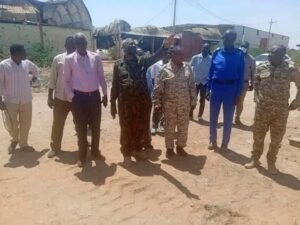
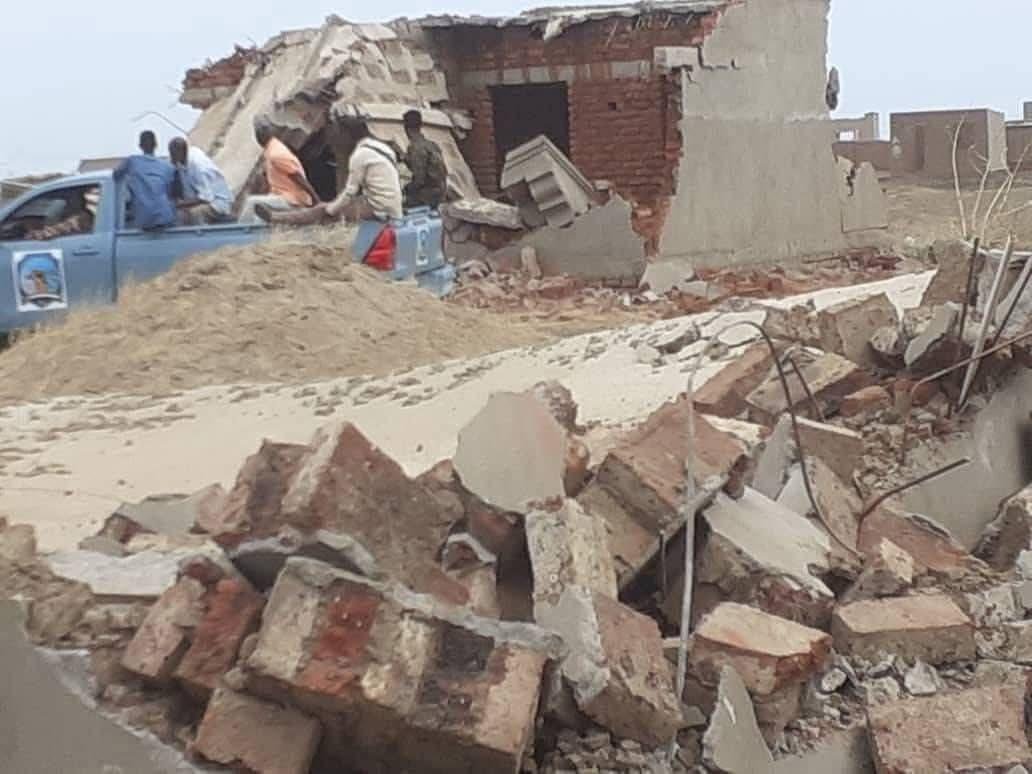
(Images of demolition campaigns for homes inside Khartoum)
Accelerated Policies in the Context of Conflict
At the beginning of July 2025, the government of Khartoum State, represented by the Land Protection and Removal of Slums and Violations Apparatus, announced the implementation of more than 60% of its plan aimed at removing informal housing in the capital, as part of a campaign described by the government as “studied” and covering all the state’s localities. The campaign began on the ground in the Al-Azaba and squares 13 and 19 in Al-Halfaya areas in Al-Bahri locality. Preceding this, in March, demolitions were also carried out in the Al-Azaba area, accompanied by a heavy security presence, amid the absence of any alternative arrangements for the affected residents.
The campaign then extended to the Al-Kheirat area in East Nile, a residential area formed over past decades, where many residents own property documents or search certificates, despite the local authorities not recognizing the legality of those documents in the context of removal.
The campaign was not limited to Khartoum State. In mid-July, the Committee for the Removal of Random Housing in Gezira State launched a major campaign in the Abdullah Masri area east of Wad Madani city, during which homes and encroachments, which the authorities said were “violating” and represented a “security and social threat,” were demolished.
Field reality indicates that most of those affected by the removals belong to socially and economically vulnerable population groups, the majority of whom are displaced from conflict areas in Darfur, South Kordofan, and the Blue Nile, who settled on the outskirts of Khartoum or other cities like Wad Madani after previous wars forced them to flee their villages. For years, these groups have been living in fragile housing conditions, lacking basic services, but it provided a minimum level of safety compared to the conflict zones they fled. With the outbreak of war again in April 2023, the number of displaced persons increased, and informal settlements expanded, making them a direct target for removal policies that did not consider their fragile conditions nor the emergency context imposed by the war.
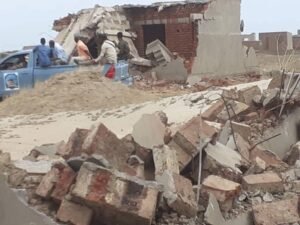
(Images of demolition campaigns for homes inside Khartoum)
Reproducing Violence and Marginalization Through State Tools
Concurrently with the field removal actions, the Sudanese digital space witnessed a noticeable escalation in inciting discourse against the residents of informal settlements, especially the poor and displaced from outside the capital. This discourse did not emerge in a vacuum but was directly linked to posts on pages affiliated with or supportive of the official state discourse, promoting messages expressing societal hatred against newcomers and those with limited incomes, such as:
-
“Preventing random housing and shacks and burning them”
-
“No second security guard except with official papers”
-
“Preventing female workers from Mayo and Al-Azhari neighborhoods from working in homes”
-
“Preventing the rental of houses to ‘Habish’ except after showing official papers”
-
“An empty plot of land? They shouldn’t set up a shack on it again”
The paradox is that these phrases spread as part of campaigns presented as restoring public order and state prestige, but their actual content is based on criminalizing poverty and entrenching a stark class distinction between the “original” city residents and the “displaced,” a description carrying a clear discriminatory charge in Sudanese political and social discourse.
This type of discourse is not just an expression of a charged public opinion, but represents an implicit trend towards “legitimizing” symbolic violence, and even preparing society to accept actual violence against vulnerable groups. In the absence of any official condemnation or warning against these trends, the digital campaigns become an extension of the field policies, contributing to the weakening of coexistence and social peace values, and entrenching class and regional classifications that threaten the social fabric in the capital and other Sudanese cities.
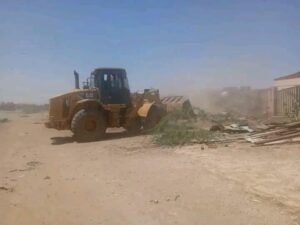
(Images of demolition campaigns for homes inside Khartoum)
Layered Violations of Housing, Displacement, and Human Dignity Rights
From the perspective of international human rights law, specifically the International Covenant on Economic, Social and Cultural Rights, any eviction or housing removal process must meet a number of standards, including prior consultation with residents, provision of alternative housing, ensuring access to appeal and grievance mechanisms, and respecting human dignity during implementation. However, the recent removal campaigns in Khartoum and Madani represent a worrying model of breaching these obligations.
The removal operations are taking place in a context witnessing a near-complete collapse of state institutions, the absence of an independent judiciary, and a lack of any effective national accountability mechanisms. Many families lost their legal documents due to the war, or never owned them originally due to the nature of repeated displacement from conflict areas. Some have even been residing on the same land for many years without being given a chance to legalize their status, making their sudden expulsion a form of forced displacement, accompanied by collective punishment targeting specific population groups.
These policies exacerbate the humanitarian crisis, as the affected find themselves once again without shelter or protection, amidst scarce aid and the absence of any housing or service alternatives. These campaigns reveal an unfair legal and administrative structure, based on implicit discrimination against specific social and geographical groups, the same groups that have suffered from political and developmental marginalization for decades.
Ultimately, these policies cannot be read in isolation from the broader political and security context in Sudan, where the objectives of controlling land and resources intersect with alarming trends to re-engineer urban space in a way that excludes the poor and marginalized from the city’s sphere. This reproduces the logic of displacement and marginalization, but this time through state tools and under a legal and administrative cover, in a stark violation of fundamental rights.

(Images of demolition campaigns for homes inside Khartoum)
Recommendations
Based on what Midan249 Observatory has documented as serious violations of housing and human dignity rights in the context of informal settlement removal campaigns in Khartoum and Gezira states, the Observatory recommends the following:
First: To the local authorities and the Sudanese government
-
Immediate halt of all removal and forced eviction campaigns, especially those carried out without judicial oversight or humanitarian assessment.
-
Commitment to international human rights standards, foremost the International Covenant on Economic, Social and Cultural Rights, including guaranteeing the provision of decent alternative housing for those affected.
-
Ensuring independent and transparent accountability regarding the violations committed, and holding those responsible for the damages inflicted on displaced and marginalized families accountable.
-
Activating grievance and redress mechanisms for the affected, and facilitating their access to fair and equitable compensation.
-
Stopping the discourse of hatred and class and regional discrimination in official and digital media, and holding entities involved in its publication or promotion accountable.
Second: To human rights and civil organizations
-
Documenting the violations accompanying the removal campaigns and raising them to the relevant international and regional bodies.
-
Supporting the affected communities legally, psychologically, and humanitarianly, including providing legal counseling and assistance in documenting housing rights.
-
Organizing advocacy campaigns to stop forced evictions and defend the right to housing and dignity.
Third: To the international community and UN agencies
-
Monitoring the ongoing urban and discriminatory violations in Sudan and exerting political and diplomatic pressure on the authorities to stop these practices.
-
Supporting the efforts of local civil organizations in providing humanitarian and legal assistance to the affected displaced persons.
-
Including the file of forced eviction and accompanying violations within the priorities of the international response in Sudan, especially in the context of the existing conflict and institutional collapse.