Arabic:https://kedencentre.org/2025/11/11/security-cell-in-al-obeid-city/
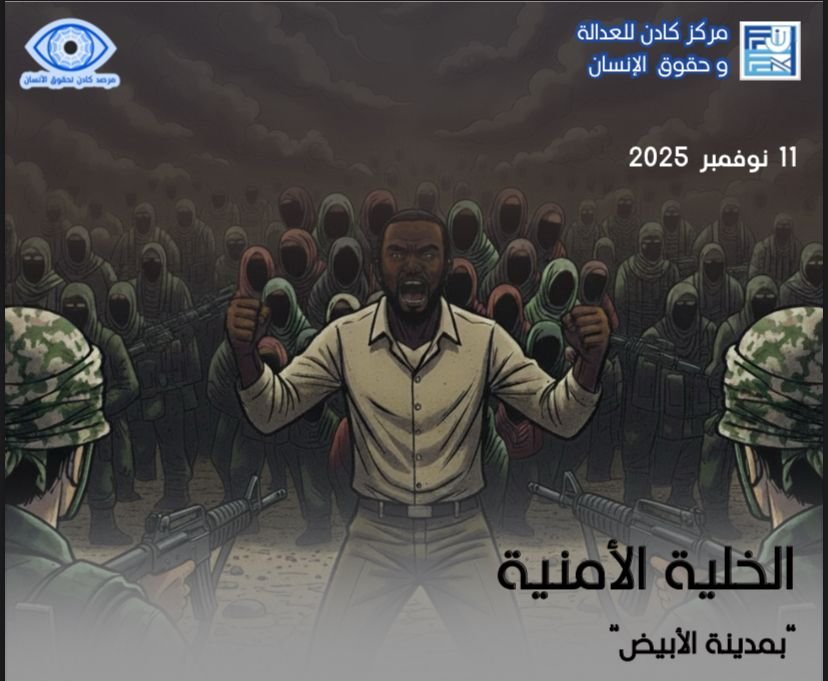
This report examines the intensive activities of the Security Cell in El Obeid, the capital of North Kordofan State, since the outbreak of war in April 2023. It analyzes the methods used for intimidation, surveillance, and control over civilians. The report focuses on the cell’s spatial distribution across the city, its arrest and surveillance techniques, detention conditions and treatment, media activities, and coordination with local authorities, while providing concrete examples such as the case of Ms. Fadwa Ahmed Adam. It also highlights crimes associated with the cell’s formation, including arbitrary arrests without judicial warrants, prolonged detention without trial, physical and psychological torture, forced inspection of phones and private correspondence, persecution of entire families simply because one member is linked to the Rapid Support Forces (RSF), and the use of private homes and civilian offices as unofficial detention centers. The report aims to present a comprehensive picture of how the Security Cell operates as a repressive tool, its direct impact on the daily lives of civilians in El Obeid, and the continuation of systematic violations outside any legal framework.
Historical Background of Security Cells in Sudan and North Kordofan
Security cells are semi-official security formations typically established in Sudan in areas controlled by regular forces or following the declaration of states of emergency. These cells comprise personnel from security and intelligence services, police, local mobilized civilians (mustanfarin), and individuals linked to the former regime. Their purpose is to gather intelligence, monitor civilian and political activity, and enforce discipline through intimidation.
In North Kordofan, the Security Cell emerged amid escalating armed conflict and was tasked with monitoring civilians and controlling public space in El Obeid. It functions as a semi-official executive arm under the direction of the National Intelligence and Security Service (NISS) and operates under the umbrella of the state government. The cell has two primary objectives: (1) conducting urgent security and intelligence operations, and (2) controlling citizens through constant intimidation and surveillance to suppress any perceived opposition or suspicious activity according to the authorities’ criteria.
The emergence of this cell reflects the persistence of security-control mechanisms inherited from the previous regime, when the ruling party’s student union served as a recruitment pool for surveillance and political influence. With the escalation of war between the Sudanese Armed Forces (SAF) and the Rapid Support Forces since April 2023, establishing a security cell in El Obeid became urgent for the authorities to maintain control over the city, censor public discourse, and impose collective punishment on any dissenting activity.
Spread and Activity of the Security Cell in El Obeid City
The Security Cell is systematically and comprehensively deployed across nearly all vital neighborhoods of El Obeid:
- Main headquarters: Located in the Grand Market (Souq al-Kabir), serving as the coordination center for field operations and receiving reports from branch offices.
- Branch office in Al-Safa neighborhood: Near Dar Al-Fikr schools on Taiba Street North, primarily used for short-term detention and interrogation.
- Former RSF buildings: Re-purposed as emergency field headquarters for temporary arrests.
- Al-Sharqah neighborhood: Contains seven offices, five of which are converted private residences used as unofficial detention sites for temporary investigation or to hide detainees before transfer to the main headquarters.
- Al-Betrol neighborhood: Hosts three additional offices.
This dense spread reflects a deliberate strategy to exploit residential areas for direct control over the population, normalizing the use of civilian space for repressive purposes. Civilians living near these offices and headquarters face heightened risk, as even routine activities become subject to monitoring and questioning.
The cell’s personnel report directly to the National Intelligence and Security Service. Most members are former students of the University of Kordofan’s pro-regime student union during the previous regime. Orders are issued hierarchically from the central security office, with an estimated membership of several dozen (no official count exists). This composition enables the cell to conduct complex, rapid, and arbitrary arrest operations coordinated between field offices and the main headquarters.
Methods of Repression and Surveillance
The cell relies on a combination of arbitrary arrests and organized digital surveillance:
- Civilians are seized from markets, homes, and workplaces without judicial warrants, often based solely on suspicion or social-media activity.
- Arrests target individuals and entire families; women have been detained simply because a relative is linked to the RSF.
- Groups inside displacement camps have been arrested and denied visitors for extended periods.
- Some detainees have been held for up to eight months without charges or trial.
Detention conditions in unprepared offices or private homes are extremely harsh: communication and visits are prohibited, and documented cases include beatings, humiliation, and threats—particularly against women and those suspected of online activity. Even after release, individuals remain under constant surveillance and are often banned from using phones or the internet, creating a persistent climate of fear and insecurity.
The cell’s media wing reinforces repression through an official Facebook page titled “الخلية الأمنية – مدينة الأبيض” (“Security Cell – El Obeid City”) and accounts run by three individuals—Ahmed Juma Jadeed, Al-Sadiq Ahmed Juma Sabah, and Nidal Ahmed Mahjoub—who spread hate speech and incitement against opponents.
On October 27, 2025, the cell held a coordination meeting with the Governor of North Kordofan to arrest anyone encouraging residents to leave the city and to activate emergency hotlines for reporting opposition activity—confirming its semi-official status and political protection.
Case Study: Ms. Fadwa Ahmed Adam
The case of Ms. Fadwa Ahmed Adam illustrates the cell’s pattern of repression:
- April 2023: Arrested with her four children and detained for one week without charge; forced into periodic reporting thereafter.
- October 2023: Re-arrested, humiliated, and beaten before release.
- Since then: Remains under constant surveillance by cell members.
This example demonstrates the use of collective punishment and intimidation as core tools for controlling civilians in El Obeid.
Conclusion
The extensive activity of the Security Cell in El Obeid reveals a parallel security dominance operating outside the law. The proliferation of offices in residential areas and the conversion of homes into detention sites signal the normalization of civilian space for repressive ends. The primary goal is to control public discourse through collective punishment and perpetual surveillance.
The Security Cell in El Obeid serves as a microcosm of Sudan’s informal repression networks and exposes the continuation of systematic violations against civilians in the city, with complete impunity and beyond any legal oversight.