Arabic: https://kedencentre.org/2025/11/21/bahri-ghosts-the-old-record-of-abuses-against-civilians/
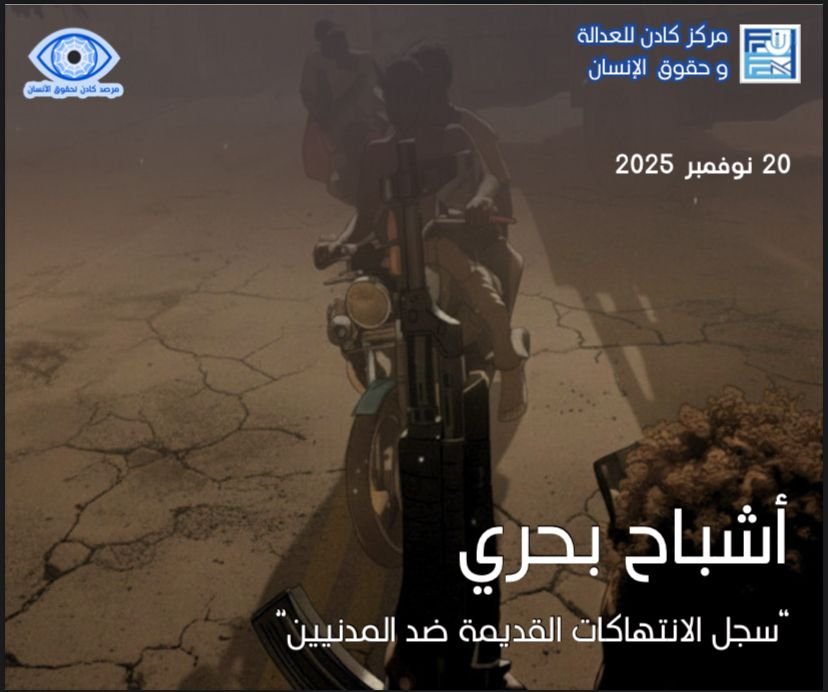
Since the outbreak of war in Sudan on April 15, 2023, the capital and its surrounding areas have witnessed grave violations against civilians. Unarmed civilians became direct targets of arbitrary arrest, torture, and threats of physical liquidation—particularly in Bahri city, which, during the period of Rapid Support Forces (RSF) control, experienced a widespread wave of both organized and random violations.
These violations centered on the use of private homes and civilian institutions as illegal detention sites, the practice of physical and psychological torture, mock trials, and forced evacuations that injured many civilians and caused permanent physical harm. This report documents the case of victim Zakaria Badawi Maurice Kowa as a living example of the abuses suffered by civilians, supported by photographic evidence of the perpetrators’ uniforms, images of the injuries he sustained, and a medical report confirming the nature and extent of the physical damage. The report concludes that these violations represent a systematic pattern requiring an independent investigation, accountability for those responsible, and protection for victims and witnesses. Kaden Human Rights Observatory stresses that documenting these past events aims to hold perpetrators accountable and ensure they do not escape justice, no matter how much time passes.
Context of Violations in Bahri Under RSF Control
Throughout the war, the three cities of the capital continued to suffer serious violations against civilians, with Bahri experiencing an intense wave of organized and indiscriminate abuses while under RSF control. Though the methods and severity varied, all violations shared two constants: they were inflicted on unarmed civilians and constituted clear breaches of international legal and humanitarian norms governing non-international armed conflicts.
Arbitrary detention emerged as the most widespread crime, becoming an almost daily practice affecting large numbers of residents on the basis of unlawful suspicions. Accusations of collaborating with the Sudanese Armed Forces (SAF) or suspicion based on ethnic identity were used as pretexts—violations of the Second Additional Protocol to the Geneva Conventions, the Universal Declaration of Human Rights, and the International Covenant on Civil and Political Rights, particularly regarding deprivation of liberty and detention outside the law.
In addition to systematic arbitrary detention, grave breaches were recorded concerning detention facilities used by the RSF. Private homes and civilian institutions were converted into prisons and “ghost houses,” becoming sites for torture, mock trials, and threats of summary execution, with no regard for the legal conditions of detention required by international humanitarian law. Survivor testimonies confirm that these locations witnessed executions and prolonged detention without charge, rendering them entirely unlawful.
Case Study: Zakaria Badawi Maurice Kowa
Among the cases documented by Kaden Observatory is the testimony of Zakaria Badawi Maurice Kowa, a 33-year-old resident of Al-Mazad North neighborhood in Bahri, deputy warehouse keeper at Siga Grain Company, and a chronic asthma patient.
Zakaria states that he was arrested multiple times since the war began, but the most dangerous incident occurred on a Wednesday evening in August 2024, when he was detained, tortured, and interrogated for hours inside a private house converted into an RSF detention center.
He recounts:
That morning he had left home to fetch water. While he was away, an RSF intelligence unit visited his house looking for him and told his family they would return. When he came back and learned what happened, he waited for hours but the unit did not reappear, so he went to sit with neighbors. In the evening, the same unit returned, found him at home, confirmed his identity, and ordered him to accompany them to the “intelligence office.”
The unit consisted of three armed men in different types of camouflage uniforms carrying Kalashnikov rifles. Zakaria identified them as belonging to the well-known RSF commander Al-Taj Foljanq, who controlled the Al-Mazad area at the time. He remembered two names: Sharif and Mohammed Ibrahim.
Before leaving, Zakaria informed his brother, collected his three ID cards and asthma inhaler, and was marched on foot to a darkened house in Al-Mazad North that had been turned into a detention site.
En route, the men began interrogating and accusing him of being a disguised SAF soldier. Upon arrival, they immediately beat him with rifle butts, accused him of being a first sergeant responsible for mortar attacks on their positions, and when he denied the charges, six or seven men dragged him into a room and beat him with sticks and hoses.
They examined his IDs: his work card was taken as proof he distributed money to civilians; his university card as evidence he coordinated airstrikes and drones. When he denied everything, they accused him of operating Bankak mobile-money accounts. Despite his explanation that his account had been closed for a month, the beating intensified.
When he tried to use his inhaler due to an asthma attack, they snatched it away, mocking him: “Tonight we’ll cure your asthma for good.”
Later, three men from a neighboring house arrived and were told Zakaria was a “Bankak guy” who moved cash to East Nile. Despite his denials, the beating and death threats continued. They pointed to a well inside the house, saying it contained bodies of executed people and that he would join them unless he confessed to being SAF intelligence.
The torture continued until his feet swelled. They mocked him for not crying, claiming it proved he was a trained soldier.
At 11:00 p.m., they forced him back home to retrieve his phone. His brother had hidden the newer devices, but the unit confiscated an old phone and his brother’s phone after searching the house, then left with further threats.
Forced Evacuation and Shooting by SAF Sniper – January 25, 2025
After SAF forces entered Al-Mazad and ordered residents to evacuate because the area would become an active combat zone, men were transported in military trucks while women were moved in pickup trucks (tatchers).
While passing through internal streets toward Al-Shambat near the Weita Flour Factory, the truck carrying civilians came under sniper fire from atop the factory. Four people were hit: two with superficial wounds, while Zakaria and another man suffered broken legs.
Zakaria lost consciousness three times. The driver refused to stop, citing extreme danger, and continued until reaching a safe area near Halfaya Bridge. The wounded were first taken to Nour Al-Huda Center, then to Al-Naw Hospital in Omdurman.
Zakaria underwent surgery and remained hospitalized for five days, followed by three months of treatment. He was later transferred to Atbara for a second precise surgery. In total, he has undergone three operations and still requires a fourth and final procedure.
Evidence
Zakaria possesses documented evidence supporting his account:
- Photographs of the uniforms worn by the arresting RSF unit.
- Clear images of the injuries sustained during and after detention.
- An official medical report confirming the nature and extent of the physical harm.
These materials constitute critical documentation that strengthens the credibility of his testimony and helps construct an accurate picture of the violations committed.
Conclusion
Zakaria’s testimony is a living example of the scale of abuses endured by civilians in Bahri during RSF control. It clearly shows how civilians became targets of illegal detention, torture, and death threats carried out in unlawful detention sites inside their own neighborhoods. It also reveals the dangers residents faced even during evacuation operations intended to ensure their safety—operations that ended with civilians being shot despite taking no part in combat.
Kaden Human Rights Observatory concludes that what occurred in Bahri cannot be regarded as isolated incidents but represents a clear pattern of systematic violations. Documenting these past events serves to hold perpetrators accountable, ensure they do not escape justice no matter how long it takes, preserve evidence accurately, guarantee victims’ rights to justice and redress, and provide necessary protection for witnesses and survivors—thereby preventing the future repetition of such crimes.