Arabic: https://kedencentre.org/2025/11/09/massacre-in-al-luweeb-village-khortaqat-north-kordofan/
On the morning of Monday, November 3, 2025, Al-Luwayb village in the Khortag administrative unit of Sheikan locality appeared like any other morning. The villagers—men, women, and children—were preparing for a routine, peaceful day. However, this morning quickly turned into an unforgettable humanitarian catastrophe. The house hosting the condolence gathering for citizen Yasser Mohammed Khalifa was crowded with civilians from the village and neighboring areas such as Fouri, Al-Arit, Umm Kokha, Uqaila, Al-Dumukiya, Al-Kharata, and Zangaja. They had all come to pay their respects to a man who had lost his life in a random traffic accident the previous day. None of the attendees could have imagined that their simple social gathering would be subjected to a horrific bloody bombardment.
Around 10:00 a.m., two drones—believed to belong to the Rapid Support Forces (RSF)—appeared in the sky over the village and fired two consecutive missiles that struck the condolence tent directly. The moment of the strike was terrifying: children’s and women’s screams rose into the air, debris and flames flew everywhere, the tent’s poles collapsed, and nearby parked vehicles caught fire. Amid thick smoke and utter chaos, the villagers desperately tried to rescue the wounded and retrieve the bodies.
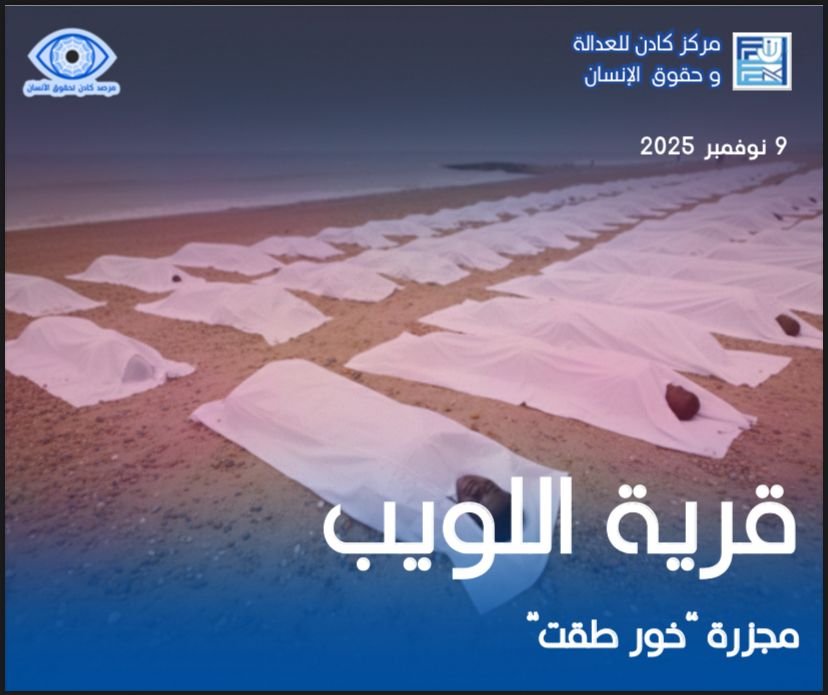
The attack resulted in 54 immediate deaths and 40 injuries, with the wounded rushed to Al-Obeid Teaching Hospital and Alawiya Yassin Clinic. Seven people remained missing as of the preparation of this report, and ten others died later due to a lack of medical resources. A documented video from the site shows two victims’ bodies prepared for burial, serving as stark evidence of the attack’s severity and the scale of human loss, while reflecting its devastating psychological and social impact on the villagers and surrounding areas.
The victims included women, children, and men alike, leaving an immense social and psychological void. Among the women killed were Mustura Hamed, Amina Ahmed Ali, Fatima Mohammed, Khalida Fathi, Aza Al-Toum, Fatima Ibrahim, Hasna Ajbna, Yaqeen Mohammed, Amina Bukhari, Samia Hussein, Hamama Mohammed, Wasal Al-Nour Mohammed, Afaf Diaa Al-Din, Iman Omar, Zahra Omar, Hawwa Dafallah, Mustura Hussein, Abida Mohammed Ahmed, Maria Makin, Aqila Mohammed, Fayiza Mohammed, and Nada Saif Allah. Women from Uqaila village included Abida Mohammed Ahmed Hamed Al-Sayyid, Hamama Mohammed Ahmed, Wasal Al-Nour Mohammed, Afaf Diaa Adel, Maria Makin Qaddal, Manuki Muslim, Amina Mohammed Hamed, Umm Ajb Abu Karshola, Rabha Bint Maye, and Bint Hussein Muslim. Additionally, men and children such as Khalid Madhatir Ibrahim and Eid Mohammed Musa were among the victims.
According to eyewitness testimonies, Yasser Mohammed Khalifa’s death was accidental and unrelated to any military activity. Joint forces were present only for routine traffic duties, with no prior security tensions before the strike. The condolence house was purely a civilian gathering, making the direct targeting of civilians unequivocally clear.
After the bombing, panic and chaos gripped the residents, who collapsed under the weight of the tragic scene. Some desperately carried the wounded and retrieved bodies, while thick smoke, the smell of burning, and flames engulfed the area. Cries and wailing echoed from every direction—a painful sight that left no one unaffected. The incident’s repercussions extended beyond human losses to psychological and social dimensions: residents suffered collective trauma from the deaths of numerous women and children, their sense of security eroded, daily life halted, economic activities dwindled, and families began fleeing to safer areas like Omdurman, Kosti, and Al-Duwaym out of fear of repeat attacks. Trust in military entities among civilians eroded further due to repeated targeting without distinction.
The incident was documented through written and audio testimonies from four eyewitnesses, photos and videos from the bombing site—including the video showing two victims’ bodies prepared for burial—medical reports from Al-Obeid Hospital and Alawiya Yassin Clinic, and verified social media posts capturing the moment of the attack and its aftermath.
The data indicates that the attack targeted an entirely civilian gathering during a sensitive social occasion—a condolence house—with no military justification, making it a potential war crime and a flagrant violation of international humanitarian law principles, particularly distinction and proportionality. The report highlights the RSF’s responsibility for the indiscriminate attack on civilians and confirms that this bombing was part of a broader campaign by RSF drones against Al-Obeid city and its surroundings. This places the Al-Luwayb incident within the context of a wider military operation deliberately targeting civilians around Al-Obeid, reinforcing the hypothesis that the attack was not random but part of a systematic policy of civilian targeting.
The responsibility hypothesis is also based on the pattern of previous attacks in the area. For instance, Al-Dumukiya village was subjected to a similar drone strike on October 7, 2024, resulting in dozens of deaths and injuries. This points to a recurring policy of targeting civilians in Khortag and adjacent areas, with attacks designed to hit crowded civilian gatherings with prior knowledge of civilian presence—further strengthening the case for direct RSF responsibility for the bombing.
In light of the above, the Kaden Human Rights Observatory emphasizes the urgent need for an immediate investigation into the incident as a potential war crime, holding all those responsible accountable, providing psychological and medical support to the affected individuals and victims’ families, documenting violations to ensure accountability for all involved parties, and working to enhance civilian protection in conflict zones in accordance with international humanitarian law. It calls for monitoring the pattern of civilian targeting around Al-Obeid and its vicinity as an ongoing threat to civilian lives, and warns the international community about the continued use of drones against civilians.
Link to video of the massacre victims: https://x.com/asad_journal01/status/1986071732688728196?s=g