
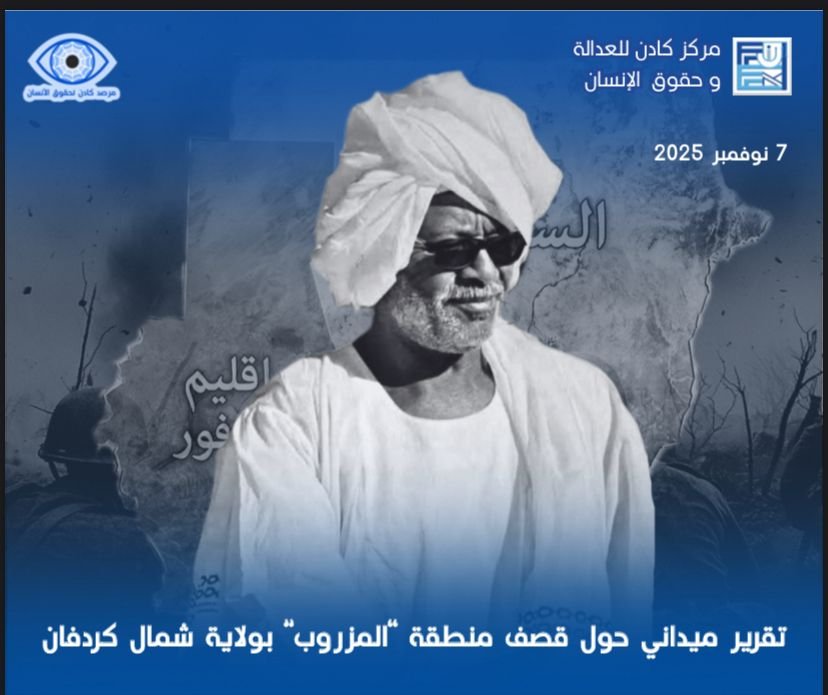
Arabic: https://kedencentre.org/2025/11/07/field-report-on-bombing-of-al-mazroob-area-north-kordofan/
Summary
On the morning of October 17, 2025, a small village in western North Kordofan state became the scene of a tragic potential war crime when a drone, believed to belong to the Sudanese Armed Forces (SAF), targeted a civilian reconciliation meeting between representatives of the Al-Majaneen tribe and field commanders from the Rapid Support Forces (RSF).
Findings from a field investigation conducted by the Kaden Observatory—based on interviews with eyewitnesses, local residents, and leaders of the Al-Majaneen tribe’s native administration—indicate that the airstrike killed approximately 53 people, including the Nazir (paramount chief) Sulaiman Jaber Juma Sahal, several omdas (local administrators) and sheikhs of the tribe, injured others, and displaced more than 230 residents from Al-Mazroub village to various locations within Bara locality.
The sequence of events and testimonies from residents confirm that the targeted meeting was not of a military nature but was intended to contain a limited dispute that had occurred the previous night between villagers and RSF elements. The incident reveals a dangerous escalation in the indiscriminate use of drones in the Sudanese conflict, with no clear distinction between civilian and military targets.
Background on the Area and General Context
Al-Mazroub area is located in the western part of North Kordofan state and administratively falls under Al-Nahud locality. It lies along the vital road linking Al-Nahud city with Al-Khuwei and Umm Ruwaba to the east, while extending westward toward the borders of West Kordofan state. It is bordered to the north by Al-Nahud city, to the east by Al-Khuwei area, to the west by the lands of Dar Hameed and Al-Majaneen, and to the south by areas administratively connected to West Kordofan.
The area is characterized by its conservative rural nature, with most residents relying on agriculture, pastoralism, and local trade. Before the outbreak of the current conflict, Al-Mazroub was a quiet area situated among several tribes with deep social ties.
In mid-October 2024, the Rapid Support Forces took control of the area as part of their military expansion in North Kordofan following the withdrawal of regular forces without significant fighting. This came after most residents had already fled due to reports of intense fighting in Bara and Al-Nahud cities. Since then, Al-Mazroub has effectively fallen under RSF control, subsequently becoming an arena of overlapping military and tribal influence.
Tribal and Social Background
The Al-Majaneen tribe is one of the most prominent tribes in both North and West Kordofan states and is historically linked to the traditional native administration and tribal system in central Sudan. The tribe is known for its wide geographic spread and strong ties with the Dar Hameed, Al-Hamar, and Kawahla tribes, as well as its considerable social and economic influence in the region.
The late Nazir Sulaiman Jaber Juma Sahal—who was killed in the bombing—was one of the most prominent figures of the native administration in Kordofan, renowned for his wisdom and constant efforts to mediate tribal reconciliations and contain local disputes. His presence had served as an important balancing factor in the civilian landscape during recent years of war, as he worked tirelessly to spare his areas of influence from direct fighting.
The late Nazir maintained communication channels with all parties, including RSF leaders, which made him an accepted mediator in minor disputes that occasionally erupted between local communities and forces stationed in the area.
Sequence of Events
On the evening of Thursday, October 16, 2025, the incident began when five RSF members entered an internet café known as “Starlink” in Al-Mazroub village attempting to loot it. Local youth confronted them, leading to a brief clash that ended with three RSF members killed and one fleeing.
Later that night, a large RSF force moved from a nearby base toward the village after receiving misleading information that the area was sheltering “remnants” (hostile groups accused of killing their members). As the force approached, the Al-Majaneen native administration, led by Omdah Abdel-Hafiz Abu Rukuk and several tribal notables, intervened, succeeded in calming the situation, and agreed to hold a reconciliation meeting the following morning with representatives from both sides.
On the morning of Friday, October 17, the meeting began in a wooded area east of Al-Mazroub village. It was attended by a delegation from the native administration headed by Nazir Sulaiman Jaber Juma Sahal, several omdas and sheikhs, as well as RSF field commanders. The atmosphere was tense but hopeful for de-escalation.
While the session was just beginning, around 11:30 a.m., a drone appeared in the sky, circled for a few minutes, and then fired three consecutive projectiles. The first struck the meeting site directly, killing most of those present. The second and third hit vehicles parked nearby.
The strike immediately killed 17 people, including Nazir Sulaiman Jaber Juma Sahal, the Omdah, and several local leaders. Four others later succumbed to their injuries at Alawiya Yassin Hospital in El Obeid. As evacuation and documentation continued, the total death toll rose to 53 members of the Al-Majaneen tribe, with more than five others wounded.
Among the dead was Professor Mohammed Hamed, chairman of the Unionist Rally Party in North Kordofan and a leading figure in the Forces of Freedom and Change in the state, adding a deeper political and social dimension to the incident.
Aftermath of the Bombing
The strike caused panic and chaos among residents, with explosions echoing across the area and confusion gripping the surviving participants. Locals began evacuating the wounded and searching the rubble for relatives, while RSF forces spread around the village to evacuate the dead.
Within hours, grief enveloped the entire area, and condolence delegations arrived from neighboring villages amid anger and bewilderment. Locals and RSF members traded accusations about who was responsible, while uncertainty persisted for days until evidence pointed to the drone likely belonging to the Sudanese Armed Forces.
In the following days, large-scale displacement began, with approximately 230 residents fleeing Al-Mazroub for safer villages within Bara locality. To preserve social cohesion, Mohammed Sulaiman Jaber, son of the late Nazir, was appointed as the new omdah of the Al-Majaneen tribe—a symbolic step affirming continuity of native leadership despite the profound wound inflicted by the event.
Who Was Responsible for the Attack?
From the first moments of the bombing, the identity of the perpetrator remained unclear, as no military or political entity issued an official statement claiming or explaining the operation. However, testimonies from residents and local sources interviewed by Kaden Observatory indicated that the drone was of a type commonly used by the Sudanese Armed Forces in recent airstrikes in Darfur and Kordofan. Some eyewitnesses reported that the drone flew at low altitude briefly before accurately firing the three projectiles at the meeting site, suggesting the target had been pre-identified.
RSF personnel in the area denied prior knowledge of the strike and stated that their forces stationed around Al-Mazroub received no aerial coordination or warning, consistent with the confusion that affected their members at the moment of the explosion.
Some residents believe the operation may have resulted from faulty intelligence, with the civilian meeting mistaken for a gathering of RSF field commanders—especially since it was held in a secluded wooded area near RSF positions.
A less common but circulating local hypothesis suggests the attack may have deliberately targeted native administration figures attempting to mediate between the warring parties—an action that, if true, would mark a dangerous shift toward targeting community leaders who represent the last line of defense against the collapse of the social fabric in the region.
Regardless of the various hypotheses, it remains indisputable that the strike hit a purely civilian and peaceful gathering with no visible military presence nearby. This makes the operation— even if based on misidentification—a clear violation of the rules of engagement and international humanitarian law, which requires parties to distinguish between civilian and military objects and to avoid actions that endanger civilians.
The absence of an official investigation and the refusal of military parties to disclose details deepens suspicions about the perpetrators’ intentions and leaves multiple possibilities open. Kaden Observatory stresses that accurately determining responsibility requires an independent, transparent field investigation with participation from neutral entities capable of accessing the site, analyzing projectile remnants, and identifying the party legally and humanely accountable for the massacre.
General Conclusions
Information gathered by Kaden Observatory from the field confirms that the targeted meeting was neither military nor hostile in nature but a civilian initiative to resolve a limited local dispute, rendering its targeting legally and morally unjustifiable.
The use of drones in this context signals a dangerous escalation in the course of the war in Sudan, with a marked increase in operations that fail to distinguish between military and civilian targets—a clear breach of international humanitarian law and the principle of distinction between combatants and civilians.
Although preliminary evidence leans toward the drone belonging to the Sudanese Armed Forces, precise legal responsibility remains contingent on an independent and impartial investigation involving human-rights and international organizations.
The incident highlights the fragility of the security situation in North Kordofan and exposes the risks facing civilian mediators due to overlapping frontlines between regular forces and armed groups. The killing of Nazir Sulaiman Jaber Juma Sahal has left a significant leadership vacuum in traditional governance and raised fears of unraveling the social fabric that has long served as a safety valve against tribal conflict in Kordofan.
Al-Mazroub, once a quiet village on the edge of the desert, has become—following this bombing—a symbol of the broader tragedy experienced by Sudanese civilians, where efforts toward peace are targeted instead of protected, and those striving for reconciliation are killed by the very instruments of war they sought to extinguish.
Recommendations and Closing Remarks
Based on field testimonies and information gathered by Kaden Observatory from multiple sources, the incident constitutes a clear breach of the laws of armed conflict and requires urgent action at both local and international levels. In this regard, the Observatory recommends the following:
- An immediate and independent investigation under the supervision of neutral parties to identify the entity responsible for the bombing and ensure accountability for those who ordered or executed the operation.
- Enabling local civil-society organizations to access the area and collect field evidence—including projectile remnants, video footage, and witness statements—before it is lost or tampered with.
- Providing humanitarian and psychological support to survivors and victims’ families, particularly given the widespread displacement caused within Bara locality.
- Ensuring the protection of native and community leaders who act as mediators between warring parties and halting any targeting or restriction of their movements.
- Preventing the recurrence of such incidents by reviewing drone-use policies and ensuring compliance with international humanitarian law, especially regarding distinction between military and civilian targets.
Kaden Observatory affirms that protecting civilians in conflict zones is a collective responsibility, and continued impunity will only lead to further repeated violations. Justice for the victims of Al-Mazroub is not merely a local matter—it is a test of the international community’s ability to enforce accountability in a protracted war whose chapters have multiplied without civilians finding any safe haven from the crossfire.